On October 29, 2021, the second-largest crypto asset in terms of market valuation, ethereum, reached an all-time price high at $4,467 per unit. The ether gas prices have risen significantly since the Altair upgrade to Ethereum’s network.
As Ethereum Tests New Price Highs, the Average Ether Transfer Fees Onchain Skyrocket
The two most valuable crypto assets in terms of market valuation have struggled with high transfer fees for years. However, this month Ethereum’s average network fee according to bitinfocharts.com data is approximately 0.000000On Saturday, October 30, bitcoin’s (BTC) average network fee according to bitinfocharts.com data shows BTC fees are around 0.00000015 BTC per byte or $3. 15 per transaction. Per transaction
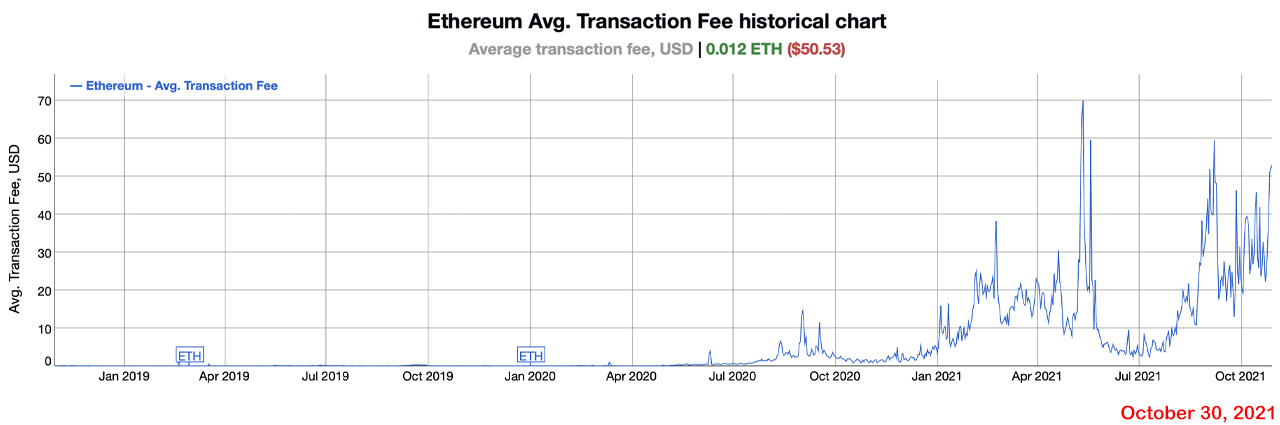
Data from bitinfocharts.com.
The same web portal tracking ethereum (ETH) gas fees notes that to move some ether, it’ll cost around 0. 012 ETH or $50. 53 per transaction. The data shows that on Saturday morning, ETH fees are 1,504% higher than BTC network fees. Data stemming from the website l2fees.info are a bit more modest in comparison to bitinfocharts.com’s metrics. At the time of writing, to move ethereum it’ll cost $18. 45 per transaction. Per transaction
Data from l2fees.info.
Transferring Ethereum-based tokens or swap tokens via smart contracts is more expensive. The transfer of token fee according to l2fees.info on Saturday is $43. 13 per transaction and over $94 to swap tokens by interacting with a smart contract. The lowest ether transaction fee of $18. 45 is still 485% higher than the average BTC transfer today.
Second-Layer Ether Transaction Costs and Swap Token Fee Estimates
Moving ethereum with a second-layer mechanism like Arbitrum or Polygon Hermez is much cheaper to use than onchain ETH transfers on the main network. Transactions using Polygon Hermez-based Ethereum transactions cost $0. 25 per transfer, while Loopring’s Zkrollup L2 solution is $0.74. Zksync costs $1 per user. 03 per send and leveraging Arbitrum One is around $4.21. Today’s fee for EVM-compliant Optimistic Rollup chain Optimism is $4. 31 per transaction. Per transaction
Using Loopring to swap tokens on Saturday is also cheaper than the $94 average cost using Ethereum’s mainnet. Loopring charges $1 for swap tokens. 07, Optimism’s fee to swap tokens is $5. 54, and Arbitrum fees to swap tokens can cost $7. 29 according to today’s metrics hosted on l2fees.info. As ETH has reached an all-time high, onchain fees are higher than usual following the Altair upgrade, which preps Ethereum for the next proof-of-stake (PoS) transition.
What do you think about Ethereum network fees rising in recent times? Please comment below to let us know your thoughts on this topic.

Image Credits: Shutterstock, Pixabay, Wiki Commons, bitinfocharts.com, l2fees.info
Disclaimer: This article is for informational purposes only. This article is not intended to be a solicitation or offer to buy or sell any products or services. Bitcoin.com does not provide investment, tax, legal, or accounting advice. The author and the company are not responsible for any loss or damage resulting from or in connection to the content, goods, or services discussed in this article.
Ethereum Derivatives Traders Position for $4K Rebound, Data Shows
Ethereum ( ETH) derivatives traders are back in full swing, with open interest, volume, and options activity all flashing signs of renewed energy across futures and options markets. ETH Max Pain Sits Near $3,300 as Traders Eye Key Expiry Levels At 10 a.m. Eastern time on Nov… Read More
ETH2 Beacon Deposit Contract Now Controls 60% Of All Ethereum: Arkham
Rain Lohmus bought $75,000 worth of ETH in 2014, which is now worth $871 million. Yet, he cannot move even a single coin.
New on-chain research from Arkham Intelligence this week shows that the wallet address holding the most ETH today is not an individual, not an exchange, not an ETF issuer, but the staking contract that secures Ethereum.
According to Arkham, the ETH2 Beacon Deposit Contract currently holds more than 72.4 million ETH, worth around $252 billion at current market prices, and represents approximately 60% of the total supply.
Ethereum’s Power Center
In terms of individuals, the research firm confirmed that the largest known individual holder of ETH is still Rain Lohmus, the founder of Estonian bank LHV, who bought 250,000 ETH in the 2014 presale for around $75,000. Those coins would now be worth roughly $871 million, but Lohmus does not have access to them because he lost the private keys years ago.
The second largest identifiable individual holder is Ethereum co-founder Vitalik Buterin, who currently holds around 240,000 ETH, worth around $840 million.
Beyond individual wallets, centralized exchanges and institutional entities collectively control some of the largest pools of Ether. Binance, for one, holds approximately 4.09 million ETH, while asset manager BlackRock holds around 3.94 million ETH, largely associated with its iShares Ethereum Trust ETF. Coinbase is the next largest institutional holder, with approximately 3.5 million ETH across multiple addresses, including cold wallets and staking reserves for its cbETH staking token.
Following suit are Upbit, Robinhood, Kraken, OKX, and Bitfinex, which appear among the top institutional holders.
Seized Funds, Stolen Funds, and Layer-2 Bridges
Arkham found that governments also appear on the leaderboard. For instance, the United States government controls around 60,000 ETH, which largely consists of seized criminal funds, including from the Potapenko/Turogin case and from seizures related to the Bitfinex hacker.
Several high-profile hacker wallets remain among large holders, including the wallet controlled by the Gatecoin exploiter, which continues to hold more than 156,000 ETH stolen back in 2016. On the infrastructure side, the Wrapped Ether (WETH) contract holds over 2.2 million ETH, representing the supply of WETH minted to make ETH compatible with ERC-20 standards.
The dataset shows that native Layer 2 bridges also account for significant locked ETH, including 833,000 ETH deposited into Arbitrum’s native bridge and around 723,000 ETH deposited into Base’s bridge. Overall, the latest on-chain data identifies staking contracts, exchanges, ETF issuers, bridges, and custody platforms as the largest known entities holding Ether today.
SPECIAL OFFER (Exclusive)
SECRET PARTNERSHIP BONUS for CryptoPotato readers: Use this link to register and unlock $1,500 in exclusive BingX Exchange rewards (limited time offer).
Ethereum Traders Just Flipped Bullish, But History Says This Is a Major Red Flag
Ethereum’s bounce toward $3,500 triggered instant FOMO, but Santiment says extreme optimism usually means price is about to disappoint.
Ethereum traders have swung sharply from extreme bearishness to extreme bullishness within just a few days, based on social media sentiment.
But fresh data suggest that when ETH nearly rebounded to $3,500 on Thursday, the crowd interpreted the move as a confirmation that the asset was “back in business.”
ETH Trader FOMO
Santiment warned that this sudden pivot is similar to the same pattern seen earlier in the week, when retail panic selling actually contributed to the rebound. Now, the rapid return of FOMO could similarly stall further upside.
According to the analytics platform, prices have shown a tendency to move in the opposite direction of the crowd, and that more neutral sentiment phases have proven to be stronger buy signal environments than euphoric ones.
Crypto trader Ted Pillows also noted that even though the altcoin is showing some rebound after this week’s sharp decline, the recovery lacks conviction. According to Pillows, the current move higher, though modest, is being driven largely by short positions being closed rather than new spot buyers stepping in. He added that Ethereum needs to reclaim the $3,600-$3,700 price range with meaningful inflows to establish strength and dismiss the risk of further downside. Without that confirmation, Pillows believes the odds still favor lower prices from here.
Despite the near-term uncertainty, some traders say the bigger picture is still pointing toward a substantial upside scenario. For instance, crypto trader “Trader Tradigrade” said that ETH’s monthly chart is currently developing what he describes as a massive Inverse Head and Shoulders pattern, with a potential price target of $14,000 once confirmed.
“Wet Blanket” Phase
As the crypto market remains sluggish, Galaxy CEO Mike Novogratz believes that this could be due to long-term holders rebalancing their net worths and diversifying away from massive concentrated holdings after a very long bull market. Novogratz deems this to be a healthy sign in the medium and long term as these positions get distributed. In the short run, however, he said that “it’s a proverbial wet blanket” and has weighed on prices.
“I do not think we have seen cycle highs. I think by year-end, we (will) see a new Fed chair, and he will be far more dovish than markets are used to. Hopefully, that gives enough narrative to propel the next leg higher.”
SPECIAL OFFER (Exclusive)
SECRET PARTNERSHIP BONUS for CryptoPotato readers: Use this link to register and unlock $1,500 in exclusive BingX Exchange rewards (limited time offer).
About the author
Chayanika has been working as a financial journalist for six years. A graduate in Political Science and Journalism, her interest lies in regulatory implications with a focus on technological evolution in the crypto realm.