
DEFI
Polymarket Doubles Down on Growth With DC Bar Launch and Brahma DeFi Deal
Polymarket is doubling down on its real-time prediction identity with a Washington, D.C., bar launch and a fresh DeFi acquisition, even as scrutiny from U.S. lawmakers intensifies.
Polymarket’s D.C. Bar Debut and Brahma Deal Signal Aggressive Growth
Polymarket has unveiled “The Situation Room,” a Washington, D.C.-based bar designed around live monitoring of global events, while separately announcing its acquisition of crypto infrastructure startup Brahma, marking a two-pronged expansion into both physical and onchain ecosystems.
The bar, slated to open March 21, transforms a familiar online behavior—tracking geopolitical developments and betting odds—into a physical venue. Screens displaying live prediction market data, news feeds, flight trackers and Bloomberg terminals are central to the experience, positioning the venue as a hybrid between a trading floor and a social hub.
Polymarket revealed the concept via its official X account, where the announcement quickly spread across trading and political circles. Early reactions leaned into humor and cultural relevance, with users joking about “monitoring the situation” late into the night while tracking global developments in real time.
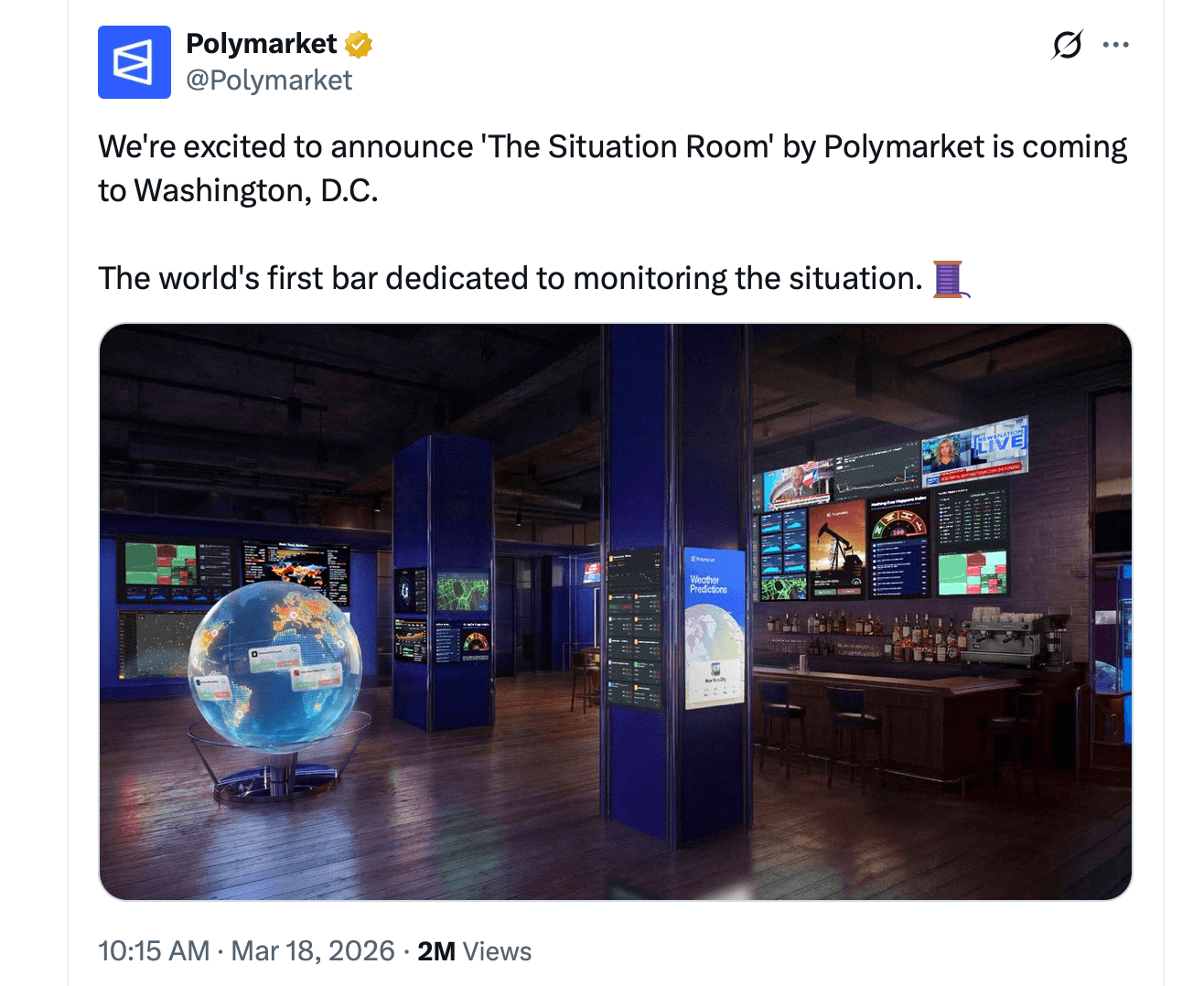
The venue’s design, based on promotional material, emphasizes a sleek, high-tech interior tailored for constant data consumption. While the exact location has not been disclosed, the Washington setting signals a deliberate alignment with policymakers, journalists and political insiders who closely follow real-world events tied to prediction markets.
The launch arrives as prediction markets face renewed attention from lawmakers. Sen. Chris Murphy, D-Conn., and Rep. Greg Casar, D-Texas, recently introduced the BETS OFF Act, which seeks to ban wagering on sensitive government actions such as military operations and assassinations.
Lawmakers have pointed to activity on platforms like Polymarket and Kalshi, including high-value bets tied to geopolitical events, as evidence of potential risks ranging from insider trading to conflicts of interest. Critics argue such markets could incentivize behavior around matters involving national security or public safety.
Polymarket has not indicated any operational changes in response to the proposed legislation and continues to expand its offerings as debate over regulation unfolds.
Alongside the bar announcement, Polymarket confirmed to Fortune that it has acquired Brahma, a decentralized finance (DeFi) infrastructure startup founded in 2021. Financial terms of the deal were not disclosed.
Brahma provides non-custodial tools including smart accounts, automated execution systems and settlement infrastructure designed to simplify complex crypto workflows. The platform has processed more than $10 billion in transaction volume, according to available data.
Polymarket said the acquisition is intended to reduce friction in its blockchain-based system, improve liquidity and enhance the overall user experience. By integrating Brahma’s tools, the company aims to streamline onboarding, asset management and trade execution across its markets.
The deal follows a series of strategic moves by Polymarket to strengthen its infrastructure. The company previously acquired QCEX, a regulated exchange and clearinghouse, as well as Dome, a developer-focused prediction market API platform.
Brahma’s team, including its co-founders, will join Polymarket to work on new products and expand market categories, with a focus on scaling access for a broader audience.
Taken together, the physical launch in Washington and the backend acquisition signal a coordinated push: one aimed at cultural visibility and user engagement, the other at technical scalability and market depth. The timing, however, places both initiatives squarely within an increasingly charged regulatory conversation.
FAQ 🔎
- What is Polymarket’s ‘Situation Room’?
A Washington, D.C., bar featuring real-time global event tracking, prediction odds and live news feeds. - Why did Polymarket acquire Brahma?
To improve blockchain infrastructure, simplify user experience and increase liquidity on its platform. - What is the BETS OFF Act?
A proposed U.S. bill aiming to ban betting on sensitive events like wars and government actions. - When does the Polymarket bar open?
The venue is scheduled to open March 21, 2026, in Washington, D.C.




DEFI
Stablecoin Market Drops $1.04B This Week as USDC Leads Outflows While USDT Holds 58% Dominance
The latest figures from defillama.com show the fiat-pegged token economy pulled back over the past week, shedding $1.04 billion since March 21. Seven of the top ten stablecoins posted net outflows during that stretch.

USDC Sees $1.37B in Outflows as Stablecoin Market Shrinks
As of this weekend, defillama.com stats show tether ( USDT) continues to dominate the sector with a market capitalization of $184.068 billion, even after a modest seven-day dip of -0.03%, or just over $56 million in outflows. USDT currently accounts for 58.42% of the stablecoin sector’s total valuation, which stands at $315.072 billion after the $1.04 billion loss.
Circle’s USDC follows with a market cap of $77.723 billion, though it logged a steeper weekly decline of -1.73%. That places USDC’s outflows at roughly $1.372 billion since March 21. In third position, sky dollar (USDS) carries a market cap of $8.146 billion, down 1.18% over the past week, while Ethena’s USDe sits fourth at $5.904 billion after a modest 0.32% weekly decline.
Rounding out the top five, Sky’s DAI stands at a $4.555 billion market cap as of Saturday, posting a 0.32% weekly decline in line with USDe’s performance. World Liberty Financial’s USD1 stablecoin shed -0.54% this past week and now stands with a market cap of $4.404 billion. PYUSD ranks seventh with a market capitalization of $3.87 billion, recording a sharper weekly drop of 4.80%.
Positions eight through ten moved against the broader trend, each posting net inflows over the same stretch. Blackrock’s BUIDL takes the eighth spot with a $2.699 billion market cap and a 6.15% weekly gain. Just behind it, Circle’s USYC ranks ninth at $2.609 billion, leading this cohort with a 7.26% increase over the past week.
Rounding out the top ten, Global Dollar’s USDG holds a $1.692 billion market cap, posting a 1.23% weekly gain. The $1.04 billion in outflows coincides with a broader pullback across the crypto economy this week, wiping out a large share of early March’s gains. Still, the week’s stablecoin data points to selective contraction rather than systemic stress, with capital rotating instead of exiting entirely.
The largest issuers absorbed the bulk of redemptions, while smaller entrants captured incremental inflows. If this pattern holds, the stablecoin stack may be entering a phase defined less by expansion and more by redistribution, where positioning and utility quietly shape the next leg.
FAQ 🔎
- What caused the $1.04 billion drop in the stablecoin market?
The decline was driven by net redemptions across seven of the top ten stablecoins, led primarily by USDC outflows. - Why is USDC seeing larger outflows than USDT?
USDC recorded heavier redemptions as capital shifted away from it while USDT maintained dominant market share. - Which stablecoins gained inflows this week?
Blackrock’s BUIDL, Circle’s USYC, and Global Dollar’s USDG posted net inflows despite the broader market decline. - What does this stablecoin shift mean for the crypto market?
The data suggests capital rotation within stablecoins rather than full exits, signaling repositioning instead of broad market stress.
DEFI
Bitcoin Lending Layer Mezo Selects Aerodrome as Primary Liquidity Hub
DEFI
SEC Chief Reinforces Crypto Framework With Clearer Token Classification Boundaries
U.S. crypto regulation takes a decisive turn as the SEC defines clearer boundaries for digital assets, narrowing its reach and signaling a shift toward structured oversight that could reshape compliance expectations and unlock market activity.

SEC Redefines Crypto Oversight Boundaries
Improving regulatory clarity for digital assets remained a central theme as Securities and Exchange Commission Chairman Paul S. Atkins reinforced the agency’s evolving approach during remarks at the Digital Asset Summit on March 24 in New York. The framework he discussed focuses on defining when tokens fall within federal securities laws through a refined interpretation of the Howey test developed jointly with the Commodity Futures Trading Commission (CFTC).
Industry participants have long struggled to determine when crypto assets fall within securities laws, a challenge the commission addressed by separating tokens into five categories based on investment contract criteria. “Our framework clarifies the contours of an investment contract and distinguishes between five categories of digital assets, four of which are not securities,” Atkins said, adding:
“We have also begun to chart a path of compliance for entrepreneurs who seek to understand when the fundraise for a crypto asset implicates the federal securities laws.”
SEC Framework Defines Key Conditions for Crypto Securities Across Funding Models
Context from the commission’s formal interpretation further explains that classification depends on the economic reality of a transaction rather than labels, with investment contracts defined by capital allocation into a common enterprise with an expectation of profit from others’ efforts. The release also highlights the diversity of crypto assets in structure and function, requiring individualized analysis rather than a universal standard, while reflecting coordination between the SEC and Commodity Futures Trading Commission on oversight boundaries.
Uncertainty around fundraising practices also drew attention as the framework outlines conditions under which token-related capital formation may trigger federal securities requirements. By identifying specific compliance triggers, the approach aims to guide developers and issuers navigating legal exposure during early-stage funding. This effort reframes oversight by concentrating on transactional characteristics rather than broad asset labeling.
Alignment with statutory authority remains a central theme as the commission positions the changes as a return to its core function of overseeing securities activity. The classification model separates digital assets by function and structure, redistributing regulatory focus toward defined investment arrangements. This recalibration reduces reliance on expansive interpretations that previously extended enforcement reach across varied crypto use cases.
Limitations of the initiative were also acknowledged, with Atkins emphasizing that the framework serves as a starting point rather than a complete solution. Durable regulatory structure, he indicated, depends on congressional action to establish comprehensive market rules. The commission’s role is confined to interpreting existing law while lawmakers evaluate broader reforms to stabilize oversight and reduce the risk of inconsistent application.
FAQ 🧭
- What does the SEC’s new crypto framework change?
It clarifies which digital assets fall outside securities laws and defines compliance triggers. - Why is the token classification system important for investors?
It reduces uncertainty and helps assess regulatory risk tied to different crypto assets. - How could this impact crypto startups and fundraising?
Projects gain clearer guidance on when token sales may require securities compliance. - Will this framework fully resolve U.S. crypto regulation?
No, lasting rules depend on future congressional action to establish broader market structure.
-

 Bitcoin4 years ago
Digital Currency Group wraps up $600 million debt capital raise
-

 Bitcoin4 years ago
Salvadoran Ecologist Claims Nayib Bukele’s Volcano-Powered Bitcoin Mine Will End in Environmental Disaster’
-

 Bitcoin4 years ago
Astra Protocol provides identity protection for The Sandbox users
-

 Bitcoin4 years ago
Where to buy Dogelon Mars after falling 15% on Thursday
-

 NFT4 years ago
DRepublic launches a combined NFT platform, ‘MetaCore’ Using EIP-364
-

 Bitcoin4 years ago
Stella, a UAE Hospitality Brand, Now Accepts Crypto
-

 Ethereum4 years ago
Ethereum prices skyrocket but Ether Gas Fees surge, fueling costly transfers
-

 Bitcoin4 years ago
Are you a Star Atlas fan?